

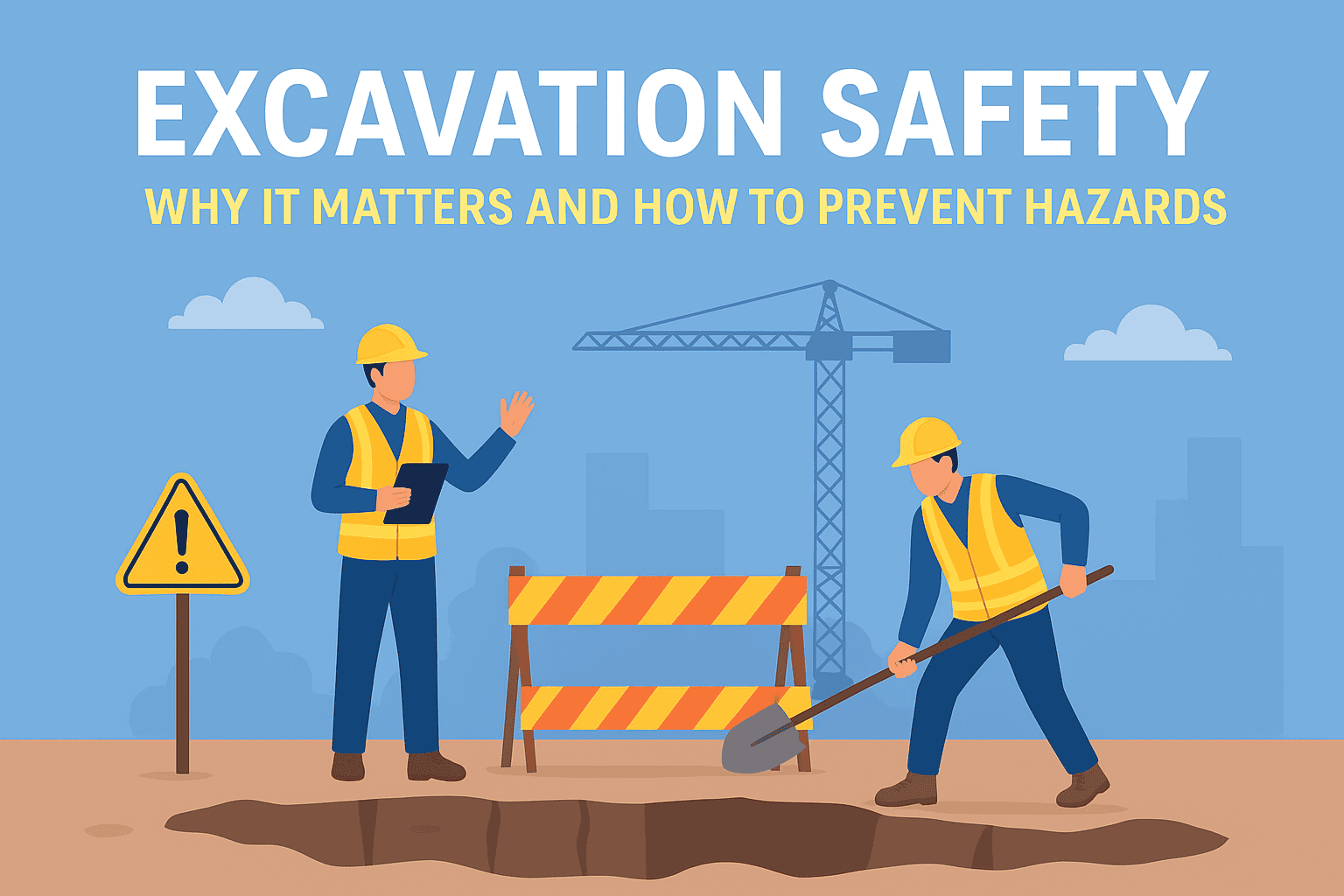
What is Excavation Or Difference between Excavation & Trenching
Excavation is any man-made cut, cavity, Trench or Depression in the Earth’s surface forced by earth removal. A trench is defined as narrow excavation (in relation to its length) made below the surface of ground. In general, the depth of the trench is greater than its width, but the width of a trench measured at bottom is not greater than 15 feet
⚠️ Common Excavation Hazards
- Cave-ins (Trench Collapse) – The most dangerous excavation hazard, often resulting in fatalities. One cubic yard of soil can weigh as much as car
- Falling Loads – Materials or equipment falling into the excavation site.
- Hazardous Atmospheres – Accumulation of toxic gases or lack of oxygen in trenches.
- Falls into Excavation – Workers or equipment falling into open excavations.
- Flooding or Water Accumulation – Sudden inflow of water due to heavy rain or broken pipelines.
- Underground Utilities – Striking gas lines, water pipes, or electrical cables.
What are the soil classification categories?
Some of the compliance methods permitted under the Excavation standards require a competent person to classifysoil and rock deposits as: ■ Stable rock; ■ Type A soil; ■ Type B soil; or ■ Type C soil.
Type A – Cohesive soils with an unconfined compressive strength of 1.5 tons per square foot (tsf) (144 kPa) or greater.Examples include: clay, silty clay, sandy clay, and clay loam.
Type B – Includes cohesive soil with an unconfined compressive strength greater than 0.5 tsf (48 kPa) but less than 1.5 tsf (144kPa) and granular cohesionless soils (such as angular gravel,similar to crushed rock, silt, silt loam, sandy loam, and, in somecases, silty clay loam and sandy clay loam).
Type C – Cohesive soil with an unconfined compressive strength of 0.5 tsf (48 kPa) or less, granular soils (including gravel, sand, and loamy sand), submerged soil or soil from which water is freely seeping, submerged rock that is not stable, or material in a sloped, layered system where the layers
dip into the excavation or with a slope of four horizontal to one
vertical
Note: Unconfined compressive strength means the load per unit area at which a soil will fail in compression. It can be determined by laboratory testing or estimated in the field using
a pocket penetrometer, thumb penetration tests, or other methods
What is a competent person?
A competent person is an individual, designated by the employer, who is capable of identifying existing and predictable hazards in the surroundings or working conditions which are unsanitary,
hazardous or dangerous to workers, and who is authorized to take prompt corrective measures to eliminate them. Under the Excavation standards, tasks performed by the competent person include:
■ Classifying soil; ■ Inspecting protective systems ■ Designing structural ramps. Preplanning
■ Monitoring water removal equipment; and ■ Conducting site inspections.
Why is preplanning important to excavation work?
No matter how many trenching, shoring, and backfilling jobs an employer has done in the past, it is important to approach each new job with care and preparation. Many on-the-job incidents result from inadequate initial planning. Waiting until after the Trenching and Excavation Safety work starts to correct mistakes in shoring or sloping slows down the operation, adds to the cost of the project, and makes a cave-in or other excavation failure more likely
What safety factors should be considered when bidding on a job?
Before preparing a bid, employers should know as much as possible about the jobsite and the materials they will need to have on hand to perform the work safely and in compliance with OSHA
standards. A safety checklist may prove helpful when employers are considering new projects. Factors to consider may include: ■ Traffic Proximity and physical condition of nearby structures
■ Soil classification ■ Surface and ground water ■ Location of the water table ■ Overhead and
underground utilities ■ Weather ■ Quantity of shoring or protective systems that may be required■ Fall protection needs■ Number of ladders that may be needed other equipment needs. Employers can gather the information they need through jobsite studies, observations, test borings for soil type or conditions, and consultations with local officials and utility companies. This information will help employers determine the amount, kind, and cost of safety equipment they will need to perform the work safely.
How can employers avoid hitting underground utility lines and pipes during excavation work?
Before starting work, the Excavation standards require employers to do the following:
Determine the approximate location(s) of utility installations including sewer, telephone, fuel, electric, and water lines. Contact and notify the utility companies or owners involved to inform them of the proposed work within established or customary local response times. Ask the utility companies or owners to establish the location of underground installations prior to the start of excavation work. If they cannot respond within 24 hours (unless the period required by state or local law is longer) or cannot
establish the exact location of the utility installations, employers may proceed with caution, which includes using detection equipment or other acceptable means to locate utility installations Determine the exact location of underground installations by safe and acceptable means when excavation operations
approach the approximate location of the installations Ensure that while the excavation is open, underground installations are protected, supported or removed as necessary to safeguard workers.
🛡️ Safety Measures for Excavation Work
✅ Soil Assessment – Identify soil type and stability before digging.
✅ Protective Systems – Use shoring, shielding, or benching to prevent cave-ins.
✅ Access and Egress – Provide safe ladders, ramps, or steps within 25 feet of workers.
✅ Barricades and Signage – Mark excavation sites clearly to prevent falls.
✅ Atmospheric Testing – Check for oxygen levels and toxic gases.
✅ Water Control – Use pumps and drainage systems to avoid flooding.
✅ Training & Supervision – Ensure workers are trained, and site is monitored by competent HSE staff.
Protective Systems
How can employers prevent cave-ins?
Sloping and benching the sides of the excavation; ■ Supporting the sides of the excavation; or■ Placing a shield between the side of the excavation and the work area
Excavation standards include:
■ Sloping the sides of the excavation to an angle not steeper than 1½:1 (for every foot of depth, the trench must be excavated back 1½ feet). A slope of this gradation is safe for any type of soil.
Designing a sloping and benching system in accord with tabulated data, such as tables and charts, approved by registered professional engineer. This data must be in writing and must include enough explanatory information (including the criteria for selecting a system and the limits on the use of the data) for the user to be able to select an appropriate protective system. At least one copy of the data,
which identifies the registered professional engineer who approved it, must be kept at the worksite during construction of the protective system. After the system is completed, the data may be stored away from the jobsite, but a copy must be provided upon request to an HSE compliance officer.
Using a trench box or shield approved by a registered professional engineer or designed in accord with tabulated data approved by a registered professional engineer.
The Excavation standards do not require a protective system when an excavation is made entirely in stable rock or when an excavation is less than 5 feet (1.52 meters) deep and a competent person has examined the ground and found no indication of a potential cave-in.
What are the requirements for safely installing and removing protective systems?
The Excavation standards require employers to take certain steps to protect workers when installing and removing support systems. For example: Members of support systems must be securely connected to
prevent sliding, falling, kickouts or predictable failure. Support systems must be installed and removed in a manner that protects workers from cave-ins and structural collapses and from being struck by members of the support system. Members of support systems must not be overloaded. Before temporary removal of individual members, additional precautions are required, such as installing other structural members to carry loads imposed on the support system. Removal must begin at, and progress from, the bottom of
the excavation. Backfilling must progress together with the removal of support systems from excavations
What other excavation hazards do employers need to address?
In addition to cave-ins and related hazards, workers involved in excavation work are exposed to hazards involving falling loads and mobile equipment. To protect workers from these hazards, OSHA requires employers to take certain precautions. For example, employers must: ■ Protect workers from excavated or other materials or equipment that could pose a hazard by falling or rolling Trenching and Excavation Safety inside the excavation by placing and keeping such materials or equipment at least 2 feet (0.61 meters) from the edge and/or by using a retaining device to keep the materials or equipment from falling or rolling into the excavation.■ Provide a warning system (such as barricades, hand or mechanical signals, or stop logs) when mobile equipment is operated adjacent to an excavation, or when such equipment
must approach the edge of an excavation, and the operator does not have a clear and direct view of the edge.■ Protect workers from loose rock or soil that could fall or roll from an excavation face by scaling to remove loose material, installing protective barricades at appropriate intervals, or using other equivalent forms of protection.■ Institute and enforce work rules prohibiting workers from working on faces of sloped or benched excavations at levels above other workers unless the workers at the lower levels
are adequately protected from the hazards of falling, rolling, or sliding material or equipment.
■ Institute and enforce work rules prohibiting workers from standing or working under loads being handled by lifting or digging equipment. ■ Require workers to stand away from vehicles being loaded
or unloaded to protect them from being struck by any spillage or falling materials. (Operators may remain inside the cab of a vehicle being loaded or unloaded if the vehicle is equipped, in accord with 29 CFR 1926.601(b)(6), to provide adequate protection for the operator.)
What is the effect of water accumulation on excavation safety and what do employers need
to do to protect workers from water-related excavation hazards?
Water in an excavation can undermine the sides of the excavation and make it more difficult for workers to get out of the excavation. The OSHA standards prohibit employers from allowing workers to enter an excavation where water has accumulated or is accumulating unless adequate precautions are
taken to protect workers. Such precautions can include special Occupational Safety and Health Administration10 support or shield systems to prevent cave-ins, water removal to control the water level, or the use of a safety harness and lifeline. If an employer uses water removal equipment to control or
prevent water accumulation, the equipment and operations must be monitored by a competent person to ensure proper use. If excavation work interrupts the natural drainage of surface water,
the OSHA standards also require the use of diversion ditches,dikes, or other suitable means to prevent surface water from entering the excavation and to provide adequate drainage of the adjacent area. In addition, a competent person must inspect excavations subject to runoffs from heavy rains, and excavations subject to such runoffs are subject to the requirements
How can employers protect workers from hazardous atmospheres inside excavations?
Atmospheric testing is required before workers enter an excavation greater than 4 feet (1.22 meters) in depth where an oxygen deficiency or a hazardous atmosphere is present orcould reasonably be expected, such as in excavations in landfill areas or excavations in areas where hazardous substances are
stored nearby. If there are any hazardous conditions present, the employer must ensure that adequate precautions are taken to prevent employee exposure to those conditions. Such precautions include providing workers with proper respiratory protection or ventilation. In addition, when controls are used
to reduce the level of atmospheric contaminants to acceptable levels, testing must be conducted as often as necessary to ensure that the atmosphere remains safe. If hazardous atmospheric conditions exist or may reasonably be expected to develop in an excavation, the employer must ensure the ready availability of emergency rescue equipment, such as breathing apparatus, a safety harness and line, or a
basket stretcher. This equipment must be attended when in use.
What means of access and egress must employers provide?
OSHA requires employers to provide ladders, steps, ramps, or other safe means of egress for workers working in trench excavations 4 feet (1.22 meters) or deeper. The means of egress must be located so as not to require workers to travel more than 25 feet (7.62 meters) laterally within the trench. Any structural ramps used solely for worker access or egress must be designed by a competent person. Structural ramps used for access or egress of equipment must be designed by a competent person qualified in structural design. Also, structural members used for ramps or runways must be uniform in thickness and
joined in a manner to prevent tripping or displacement
When must employers conduct site inspections?
Employers must ensure that a competent person inspects all excavations, adjacent areas, and protective systems daily for possible cave-ins, indications of failures in protective systems and equipment, hazardous atmospheres, and other hazardous conditions. Inspections must be done prior to the start of
work and as needed throughout the shift. Inspections are also required after natural events, such as rainstorms, or other hazard-increasing occurrences, such as blasting work. If an inspector finds any unsafe conditions during an inspection, the employer must clear workers from the hazardous area until the
necessary safety precautions have been taken
Conclusion
When employers share the details of their safety and health programs with workers, they should emphasize the critical role workers play in keeping the jobsite safe. Employers also need
to emphasize specific practices that will help reduce the risk of on-the-job injuries at excavation sites. Such practices can include the following:
■ Know where underground utilities are located before digging.
■ Keep excavated soil (spoils) and other materials at least
2 feet (0.61 meters) from trench edges.
■ Keep heavy equipment away from trench edges.
■ Identify any equipment or activities that could affect
trench stability.
■ Test for atmospheric hazards such as low oxygen,
hazardous fumes, and toxic gases when workers are more
than 4 feet deep.
■ Inspect trenches at the start of each shift.
■ Inspect trenches following a rainstorm or other water
intrusion.
■ Inspect trenches after any occurrence that could have
changed conditions in the trench.
■ Do not work under suspended or raised loads and materials.
■ Ensure that personnel wear high-visibility or other suitable
clothing when exposed to vehicular traffic.
📜 Regulations in the Middle East
- OSHA Standards (29 CFR 1926 Subpart P) are widely referenced.
- Saudi Arabia, UAE, and Qatar construction safety codes require strict excavation safety compliance.
- Non-compliance can lead to heavy fines, project delays, or even site shutdowns.
✅ Final Thoughts
Excavation safety is not just a legal requirement — it’s about saving lives. A single mistake in trenching can lead to tragic consequences. HSE professionals must ensure that proper planning, protective systems, and monitoring are always in place.


The Moral, Legal and economic reasons for promoting good standards of safety within an organization - hseraj
[…] Excavation Safety – hseraj […]