

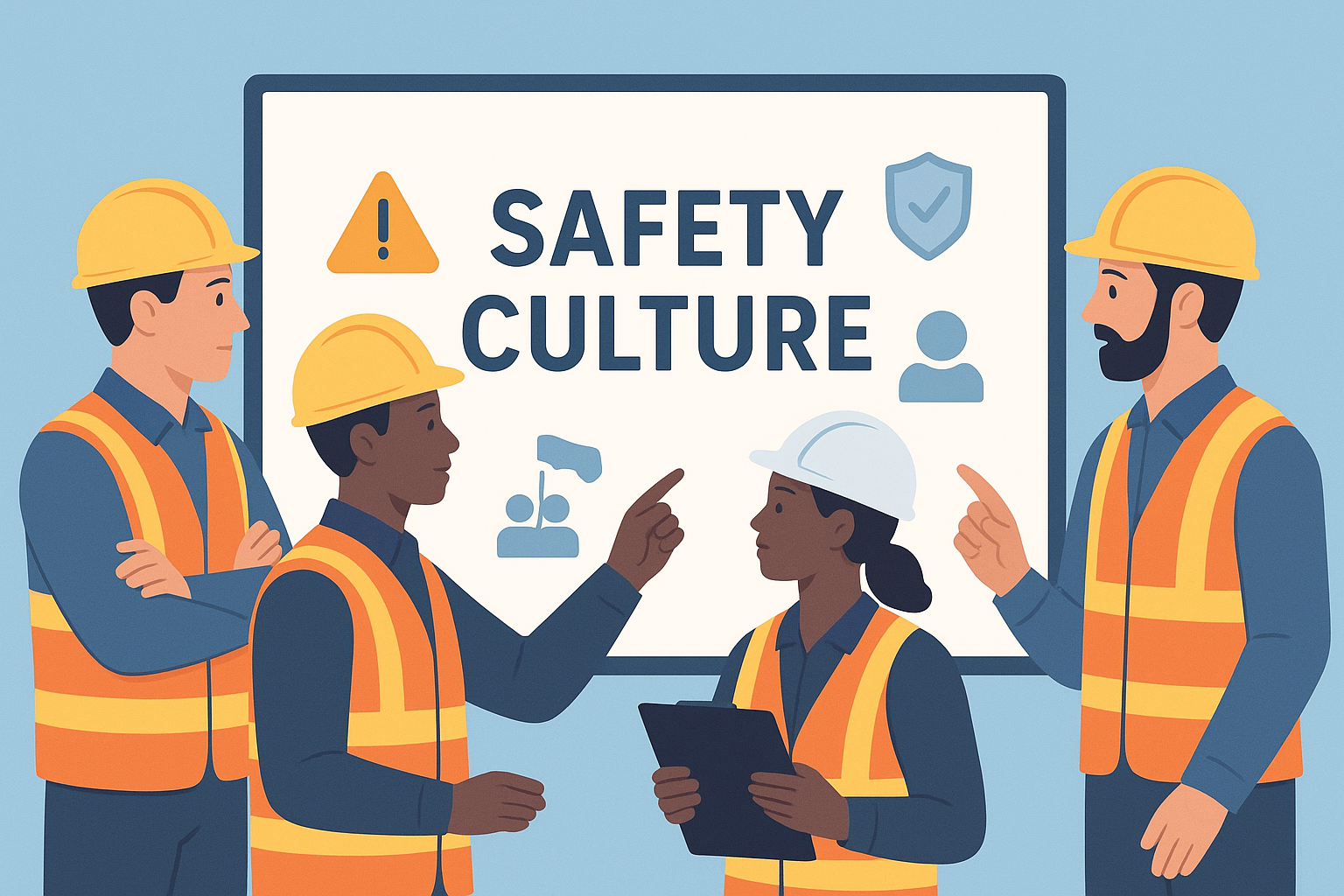
The culture of an organization is said to have a significant impact upon performance. The safety culture of an organization is a concept that describes the attitudes and belief of an organization in terms of its safety performance.
In terms of safety culture, there is a range of definitions cited by public enquires and research bodies. These definitions invariably cite poor management control as a key factor leading directly to serious accidents or disasters. For example, the absence of a safety culture is said
to have played a major part in the nuclear reactor disaster at Chernobyl in 1986. The team in control of the reactor, being influenced by the need to complete an unusual test quickly, removed layer after layer of the safety controls – introduced to keep them safe – in order to carry out a test. This resulted in the reactor being operated under conditions which gave rise to serious instability in the reactor, resulting in the disaster. The subsequent enquiry found that ‘the control team
operated in a managerial culture that failed to discourage he taking of risks where other priorities intervened. the need to complete the test quickly’. In order to be truly effective in the management of fire or health and safety, the organization must develop what has become known as a positive safety culture based on proactive management of safety issues.
A number of studies carried out by the HSE have sown that significant numbers of major injury and fatal accidents could have been prevented by positive action by management. These studies established that in the order of 70% of fatal accidents in construction and maintenance activities could have been prevented by direct, positive, management action. The studies emphasize the critical role of the organization in establishing a robust health and safety culture and a safety management system aimed at preventing human error, as well as establishing the ‘hardware’ controls for health and safety.
In the fi eld of safety management, the most widely used definition of culture is that suggested by the
Advisory Committee on the Safety of Nuclear Installations. This definition was used to shape the guidance given by the HSE in its guidance HSG65 ‘Successful health and safety management’:
The safety culture of an organization is the product of individual and group values, attitudes, perceptions, competencies and patterns of behavior that determine the commitment to, and the style and proficiency of, an organization’s health and safety management. Organizations with a positive safety culture are characterized by communications founded on mutual trust, by shared perceptions of the importance of safety and by confidence in the efficiency of preventive measures.
The term safety climate is used to refer to psychological characteristics of employees, in other words the way that people feel about the safety culture within an organization. An investigation into safety culture by the HSE into the two major rail crashes in 2000 and 2001concluded that the safety climate within an organization is an expression of the values, attitudes and perceptions of employees with regard to safety within an organization. So, it can be seen that the safety climate of an organization is an important influence on its overall safety culture. If employees’ own values, attitudes and perceptions do not motivate them to support and/or comply with safety rules the safety culture will be a negative one.
The investigation into safety climate argued that there were five drivers for a positive safety climate:
Leadership
Whereby senior managers provide a demonstration of safety as having a high status in the organization by providing:
➤ An adequate budget and resources for managing safety (including safety specialists)
➤ Opportunities for effective safety communication
➤ Training and support to personnel
➤ High visibility of management’s commitment to safety
➤ Effective safety management systems led by a strategic level safety management team.
Communication
Whereby there are effective:
➤ Channels for top-down, bottom-up and horizontal
communication on safety matters
➤ Systems for reporting safety issues
➤ Transfer of information between individuals, departments and teams.
Involvement of staff
Effective employee participation should be supported with good systems and training, and allow employees to be responsible personally for areas of safety.
The existence of a learning culture
Whereby systems are in place that allow:
➤ Employees to contribute ideas for improvement in procedures
➤ Effective analysis of incidents, and good communications of the outcomes.
The existence of a just culture
Organizations with a blame culture overemphasize individual blame for human error, at the expense of correcting defective systems. Blame allocates fault and responsibility to the individual making the error, rather than to the system, organization or management process.
To reduce the impact of a blame culture organizations
should:
➤ Promote accountability
➤ Understand the mechanism of human error
➤ Demonstrate care and concern towards employees
➤ Maintain confidentiality
➤ Enable employees to feel that they are able to report problems without fear of reprisal.
There are various ‘safety climate’ assessment tools available which allow employers and responsible persons to assess the state of their safety culture. These normally take the form of staff questionnaires which can be used along with tangible indicators of safety culture
The importance of creating a positive safety culture cannot be overstated. In extreme cases a positive safety culture can make the difference between the success or failure of an organization’s survival.
In his report on the Ladbroke Grove rail enquiry Lord Cullen stated: ‘A key factor in the industry is the prevailing culture, of which safety culture is an integral part. There is a clear link between good safety and good businesses. He then went on to quote in submission of the HSE: ‘. . . the need for a positive safety culture is the most fundamental brought before the Inquiry’.
The benefits of positive safety culture
Benefits to the organization
Less time lost through accidents organization Reduced risk of civil claims for compensation
Reduced risk of enforcement action Enhanced company image Greater efficiency
Less production downtime Minimized insurance premiums
Having a competent and committed workforce Making better quality decisions as a result
of involving the workforce
Benefits to the individual
Less risk of injury individual Less risk to work-related ill health
Less risk of work-related stress
Increased chances of continued employment
Working for a competent and committed team with competent and committed
management
Being clear and confident about what is expected from management Increased job satisfaction from being empowered to contribute to safety management
Tangible indicators of safety culture
It is never simple to discern the state of the safety culture within organizations. Some say that one can get a ‘feel’ for a positive or negative safety culture by visiting the workplace or in some cases reviewing the products or documentation of an organization. These subjective assessments are of limited value and rarely allow the situation at any one time to be quantified, e.g. is the safety culture worse now than it was last year?
Without quantifiable measures safety culture (as is the case with all aspects of an organization) cannot be effectively managed. It is therefore vital for managers to have some idea of the culture within their organizations. Moreover, safety culture is critical to the success or failure of risk management within an organization; it is important to attempt to understand whether the safety culture is working for or against the aims of management. Quantifiable data is available to assist managers assess the safety culture, from the following indicators:
➤ Accident/incident occurrence and reporting rates
➤ Sickness and absenteeism
➤ Staff turnover
➤ Compliance with safety rules
➤ Complaints
➤ Output quality
➤ Staff involvement.
When attempting to determine the nature of an organization’s safety culture, is it vital not to draw too fi rm a conclusion from one single indicator. Astute managers will recognize that there are a number of variable factors that may influence any one of the indicators. More confidence can be placed in conclusions that are drawn from a cluster of indicators, tending to suggest a similar picture.
Accident/incident occurrence and reporting rates
The most obvious implication to draw from accident/ incident rates or the number of fi res or false alarms is that if they are going up period on period it is likely that there is a negative culture. However, it is important to consider, not only the numbers of these safety events, but also the seriousness of the outcomes. If it is the case that there are many reports of personal injury accidents but the injuries sustained are negligible, it may Nevertheless sickness and absenteeism rates are seen as a reliable indicator of the levels of motivation and commitment to work. Job roles that provide little satisfaction for the employee will often experience high levels of sickness.
Staff turnover
Again, staff turnover is often quoted as a good indicator of organizational culture, but again caution must be exercised when drawing inferences about the culture in a particular organization. In general, it is thought that the more positive a safety culture in an organization the greater the feelings of loyalty among the staff and therefore the less the turnover. There are, however, a number
of factors that affect staff turnover that have little relationship
with safety culture, including:
➤ Industry norms
➤ Remuneration packages of competitors
➤ Life/work balance issues for the individual
➤ Personal career aspirations.
Compliance with safety rules
An examination of the degree to which safety rules are applied or breached at work gives a good indication of the effectiveness of the safety culture. This is because almost all factors that affect the implementation of safety rules are in the direct control of the management. Therefore, it is possible to draw reasonable inferences from an analysis of breaches of safety rules. With a positive safety culture at work, individuals will be aware of the rules, have sufficient physical resources, time and competence to apply them and be motivated to do so. Active monitoring systems will enable instances of breaches in safety rules. Particularly effective formal active monitoring systems include safety tours,
inspections and workplace audits. Less formal but none the less relevant are those occasions when observing behavior in the workplace occurs as a result of visiting the workplace for other reasons, for example quality control or welfare. Fire doors wedged open, bad housekeeping and breaches of security arrangements that are identified during active monitoring will provide a good indication
that routine fire safety management is poor.
Complaints
The level of complaints in a workplace can be indicative of a dissatisfied workforce. Dissatisfied workers are not motivated to comply with any management systems. Again, it is a fairly good indicator of the state of the culture because if there is dissatisfaction within the workplace it is likely that it is as a result of the actions or omissions of management. However, a complete absence of complaints from
the workforce may indicate a atmosphere of fear or uncertainty. A workforce that is competent and confident of management’s ability to respond positively to issues raised will result from a positive culture. Managers need to analyze the levels and nature of complaints with some caution in order to get a feel as to whether they are a positive or negative indicator.
Output quality
In organizations that produce either goods or services, quality of the output is fundamental to business success. Poor output quality can be indicative of a poor safety quality. If poor output quality demonstrates low levels of management control, and if quality control management is poor, it is likely that management is poor across the organization thus having a direct bearing upon safety. Poor management will adversely affect employees’ motivation. Employees that are not motivated are likely
to take less care of the outputs from their work and so the cycle continues.
Staff involvement
The degree to which staff are willing to become involved in non-core or social aspects of the work may provide management with a useful insight into the state of workplace culture. Among the activities for which quantitative data can be made available are:
➤ Suggestion schemes
➤ Work committees
➤ Social activities
➤ Response to attitude surveys.
How to assist in the development of a positive safety culture within an
Organization
While the guidance contained in current fire safety documentation is a little sparse on fi re safety culture, the HSE describe in their guidance document HSG65 – ‘Effective health and safety management’ that there are four building blocks to an effective safety culture. The blocks are
often classified as the ‘four Cs’ of control, cooperation, communication and competence. The following sections discuss these four Cs:
Control – the methods by which an organization controls its safety performance
Cooperation – the means that an organization will secure the cooperation between individuals, safety
representatives and groups
➤ Communication – the methods by which the organization will communicate in, through and out of, the organization
➤ Competence – the means by which the organization manages the competency levels of individuals and teams.
Factors promoting a negative culture
It can be safely assumed that the absence of all the factors discussed above will promote a
negative safety culture. If an organization fails to provide a working environment that nurtures a positive culture it will have a direct impact upon the organization and the employees.
The factors that promote a negative safety culture include:
➤ Management behavior and decision making
➤ Staff feeling undervalued
➤ Job demands
➤ Role ambiguity.
People respond to a negative work culture in a number of ways, some will become cynical and ambivalent towards work, others will seek to want to deliberately sabotage the
organization’s plans. A common outcome of a negative culture is individual work-related
stress. If stress is intense and goes on for some time it can lead to mental and physical
ill health, i.e. depression, nervous breakdown, heart disease.
External influences on safety culture
Key among the external influences impacting on the safety culture are:
➤ Legal
➤ Economical
➤ Stakeholder expectations
➤ Technical.
A useful example of changing attitudes of the public relates to the introduction of the mandatory wearing of seat belts in cars. When compulsory use of belts was first introduced many drivers had never used them. Initially it was found that drivers did not use them, stating that:
➤ They found them uncomfortable
➤ They could not see the need
➤ They cost lives by trapping you in the
car after a crash
➤ They had never been hurt in a crash so why did they need a belt. Most of these objections were based on the general public’s attitude to the imposition of seat belts on them. Over time people
have changed their attitudes and, therefore, their behavior has changed. This has been achieved through various means, such as advertising, law enforcement, provision of information, etc.
Case study
On the evening of 6 March 1987 a British car ferry, the Herald of Free Enterprise, left the dockside at Zeebrugge, Belgium, for a routine crossing of the North Sea. The ship was of a design called ‘roll on roll off’ (RORO) whereby vehicles drove through large doors at one end of the ship when loading and drove out through similar doors at the other end to disembark. RORO vessels are constructed
with large, unrestricted car decks for maximum capacity to allow them to load and unload quickly.
Shortly after leaving the port, while many of her 500 plus passengers were in the restaurant or buying duty free goods, the ship suddenly began to list to port. Within 90 seconds, she had settled on her side on the seabed and, despite rescue craft being on the scene in as little as 15 minutes, a total of 193 passengers and crew died. It was the worst British peacetime accident since the Titanic.
The subsequent public inquiry found that the bow doors through which cars and lorries were loaded had not been closed before she left her berth. As a result, water began entering the car deck and very quickly affected her stability, even though the sea was calm. The accident involved a phenomenon called the ‘free water effect’, which can cause catastrophic instability in vessels when even a few centimeters of water enter a hold or deck and, moving when the vessel rolls or turns, destroy its stability. It was the policy of the company at the time that the ship did not sail with the bow doors open. However, the routine practice had evolved to leave port with the doors open in order to allow the fumes which had built up in the hold during loading to dissipate. Members of the crew were very well aware of the risks associated with this routine violation of a fundamental safety rule and attempted to bring it to the attention of senior managers. The inquiry into the disaster, conducted by Sir Richard Sheen, found that workers had in fact raised their concerns about the risk of leaving the bow doors open on five separate occasions, but the message got lost in middle management. The inquiry concluded that the
operating company, Townsend Thoresen, was negligent at every level and ‘From the top to the bottom, the corporate body was infected with the disease of sloppiness.’ A coroner’s inquest into the capsizing of the Herald of Free Enterprise returned a verdict of unlawful killing. Many of the victims’ families made it clear they wished to see the Townsend Thoresen company directors (now part
of P&O) face prosecution but due to the existing legal framework it was not possible in this particular case. Charges of manslaughter were bought against the company on the basis that the company could be held criminally liable for manslaughter, that is, the unlawful killing by a corporate body of a person. However, the prosecution of P&O for corporate manslaughter ultimately failed, since it was ruled that a prosecution can only succeed if within the corporate body a person who could be described as ‘the controlling mind of the company’ could be identified as responsible, and that the identified person was guilty of gross criminal negligence.
For more case studies and recent studies the following link can be more useful
Safety as a Core Value | Occupational Safety and Health Administration


Leave a Reply